Newsletter Subscribe
Enter your email address below and subscribe to our newsletter

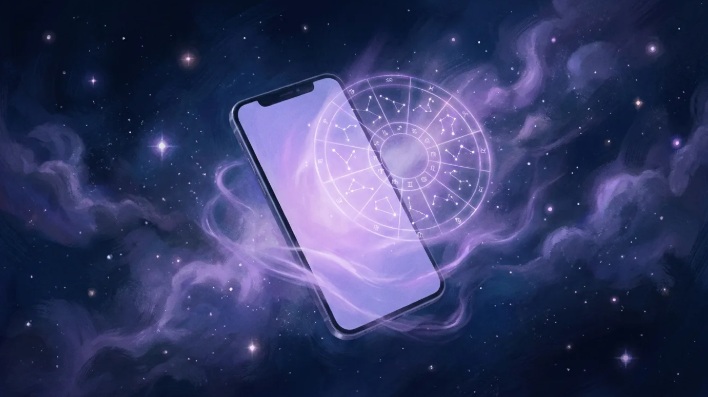
There is a quiet revolution happening in the world of self-reflection. The tools people have turned to for centuries — tarot cards, birth charts, lunar calendars — are being reimagined by artificial intelligence. Where seekers once read a fixed horoscope or drew a card in silence, they now enter into a dialogue with systems that weave tarot symbolism, planetary movements, and lunar cycles into one coherent, deeply personal narrative.
For most of their history, self-reflection tools were static. A daily horoscope was written for millions of Aries at once. A tarot book offered the same paragraph for the Tower, whether you were asking about a breakup or a business decision. A moon-phase calendar told you the Moon was waning, full stop — it never asked what you were letting go of.
AI changes the fundamental dynamic. Instead of fixed text, you get a responsive conversation. You can ask follow-up questions, share context about your life, and receive interpretations that adapt to your circumstances. In the realm of inner life, that shift feels especially profound, because self-reflection has always been personal. Now the tools finally are too.
Tarot has always been a storytelling device. A reader lays out cards and helps the querent see their situation reflected in archetypal imagery — the Fool’s leap, the Hermit’s lantern, the Ten of Swords’ rock bottom. The power was never in the cardboard; it was in the conversation around it.
AI-powered tarot keeps that conversational core and extends it. A modern reading can draw a spread, interpret each card in light of your specific question, and stay with you as you unpack what it means. Pull the Five of Cups about a lost opportunity, and you get an exploration of your loss, not a generic definition.
One of the biggest barriers in tarot has always been interpretation. The Celtic Cross has ten positions, each with a distinct role, and newcomers often stare at the layout without knowing where to begin. AI removes that friction by narrating the spread as a story — showing how the card in “the challenge” position relates to the one in “the outcome” position. The learning curve flattens, and more people experience what makes tarot valuable in the first place.
If tarot is the storytelling layer, astrology’s transits are the timing layer. They describe how the planets’ current positions interact with your birth chart — the astrological equivalent of a weather forecast for your inner life.
The problem has always been complexity. Calculating transits requires precise birth data and ephemeris tables, and interpreting them demands fluency in a symbolic language most people never learn. AI collapses that distance. Enter your birth details once, and you can ask plain questions — “What’s the theme of this month for me?” — and receive an answer grounded in your actual chart, not a sun-sign column. Getting an astrology reading that accounts for your transits used to require booking a professional astrologer; now that depth of personalization is available on demand, in conversation.
There is also a philosophical shift worth noting. Older astrology often framed transits as fate — things that would happen to you. Conversational AI tends to frame them as weather: conditions to prepare for, not verdicts to fear. A challenging Mars transit becomes a prompt to channel energy into exercise or a difficult conversation rather than a warning of inevitable conflict. That reframing — from prediction to preparation — is arguably the healthiest thing to happen to popular astrology in decades.
While transits operate on the scale of months and years, the Moon moves fast — changing signs roughly every two and a half days. Your Moon sign, the sign the Moon occupied at your birth, has long been considered the key to your emotional nature: how you process feelings, what makes you feel safe, how you recharge.
AI tools are making lunar awareness practical rather than merely poetic. Instead of vaguely knowing the Moon is “in Scorpio,” you can receive reflections tuned to your own Moon sign — why a Scorpio Moon day might stir intensity for you while leaving a friend untouched. Many seekers now treat the lunar cycle as a built-in review rhythm: new Moon for setting intentions, full Moon for honest assessment, waning Moon for release.
So what does this transformation mean for someone who turns to these tools for guidance? Several things, all worth taking seriously.
First, access has exploded. Depth that once required years of study or expensive sessions with practitioners is now available to anyone with a question and a few minutes. A curious beginner can explore an online tarot spread, check their current transits, and reflect on their Moon sign in a single sitting — guided the whole way.
Second, the experience is more active. Static horoscopes asked nothing of you; conversational tools ask everything. They prompt, they challenge, they ask “what does this mean to you?” That interactivity makes self-reflection more effective, because reflection is a skill that improves with practice, and practice requires a partner willing to push back.
Third, discernment matters more than ever. With guidance this accessible and this fluent, it is easy to mistake a compelling narrative for truth. The healthiest seekers will treat AI-assisted readings the way wise readers always treated tarot and astrology: as mirrors, not oracles. The value lies in the reflection they provoke, not in any claim about the future.
Tarot, transits, and Moon signs have survived for centuries because they do something humans need: they externalize the inner life, giving shape to feelings and questions that are hard to hold alone. AI has not changed that core function. It has changed the interface — from static to conversational, from generic to personal, from occasional to always available.
The cards still speak in symbols. The planets still keep their slow time. The Moon still waxes and wanes. But now, when you sit down with these ancient tools, something sits down with you — ready to listen, ready to remember, and ready to help you hear what you already know.